On the afternoon of August 22, the Mono County Sheriff SAR team was paged for an InReach activation from a climber who had become stranded after getting off route in the Mendenhall Couloir on Laurel Mountain near Mammoth Lakes, Calif. The Mendenhall is a complex alpine gully with loose rock, route-finding, exposure, and significant objective hazards. Off-route travel can quickly lead to increasingly vertical, unprotectable 5th-class terrain with no viable means of continuing either up or down. The subject followed what they believed to be the established route, making several 5th-class moves hundreds of feet up into an incorrect gully. He ultimately stopped on a 6-inch-wide ledge and activated his InReach at 1320 hours, when he was approximately 200 feet outside the main route.
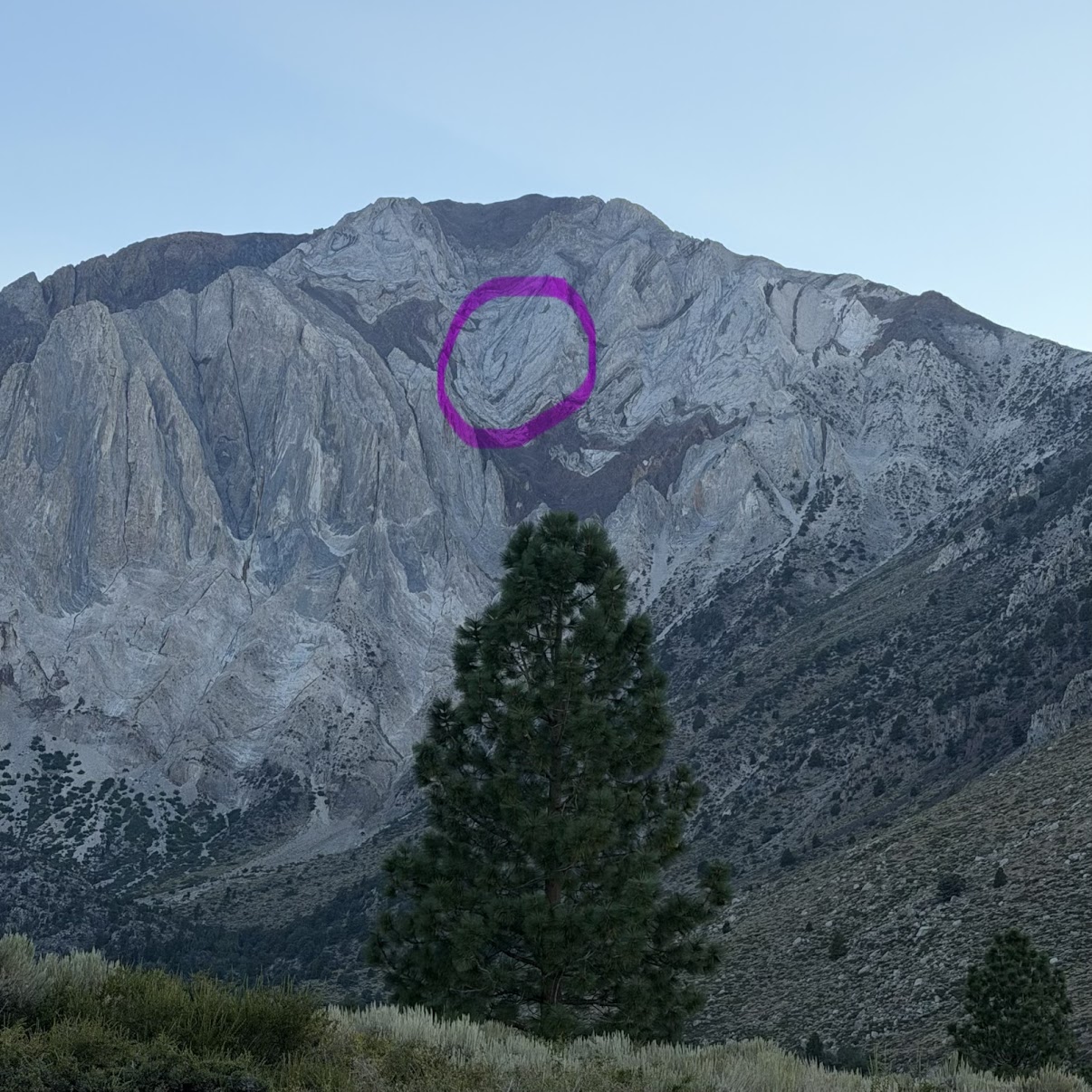
View of the Mendenhall Couloir on Laurel Mountain. Circled is area where subject was located.
Similar incidents in the Mendenhall have historically been resolved using a larger-lift UH-60 variant helicopter and hoist rescue, or by coaching the subject(s) into safer terrain. With winds gusting to 40 knots at 11,000 feet, the team quickly ruled out relying on a potential hoist operation.
In an effort to expedite ground-team deployment, the team made an atypical decision to deploy field teams directly from the SAR building in Mammoth Lakes rather than following the normal sequence of establishing a rescue base and deploying from there. The initial deployment consisted of a four-person OHV/technical rescue team (Team 1) and a two-person communications/spotting team (Team 2). Based on the GPS location obtained from the initial Garmin activation, Operations decided the team should enter the Mendenhall from the top down rather than using the traditional bottom-up approach.
Team 1 deployed with significant rope-rescue equipment, including two 600-foot ropes, a RotoHammer bolting kit, mechanical-advantage systems, edge protection, personal rigging equipment, medical gear, radios, T-Satellite connected team phones, PPE, and additional personal equipment. The equipment was consolidated from the first- and second-out rescue trucks and transported by OHV up the Laurel Lakes 4×4 road. From the trailhead near the saddle between Laurel and Bloody Mountains, the team climbed several miles and several thousand feet to the summit of Laurel while carrying the heavy equipment.
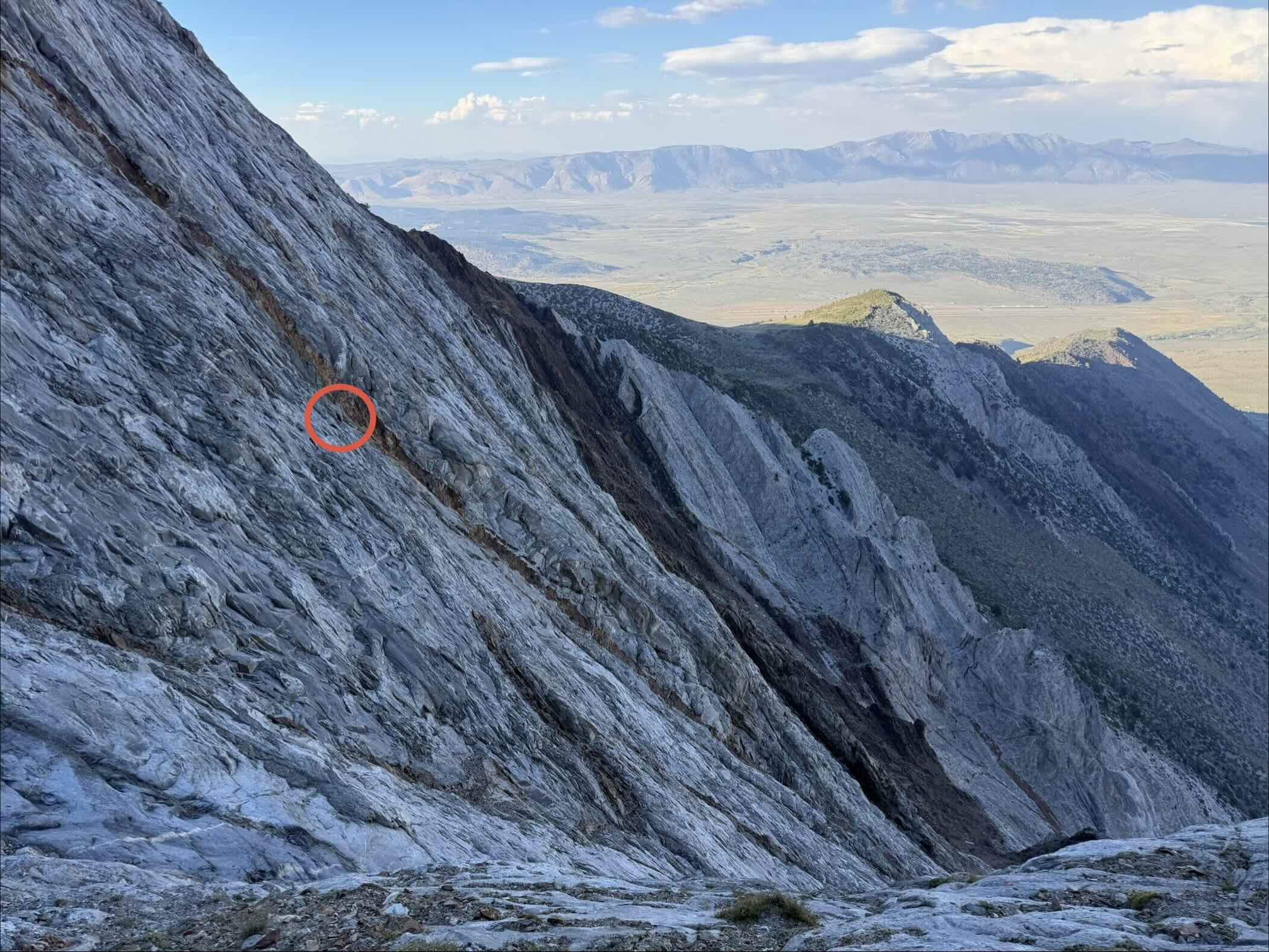
First visual of subject from just above main gully.
Operations and a Sheriff’s Office Deputy/SAR Coordinator met with six additional members at Mammoth Lakes Airport, now established as Rescue Base. Air resources had been requested, and H-42 from Fresno, California, ultimately accepted the mission. Despite the warm temperature and high winds which created operational limitations for the smaller helicopter, H-42 inserted two rescuers (one at a time), Team 3, approximately 700 feet below the summit on the north side of Laurel Mountain. The helicopter crew was able to get a visual on the subject during a reconnaissance flyover, and conveyed the precarious scene to rescuers.
Team 3 was inserted with minimal technical equipment beyond personal rigging gear, as most critical equipment was already being carried up the mountain by Team 1. Team 1, now a team of three, continued toward the summit as Team 3 was inserted. A subsequent equipment check by Team 1 revealed that the RotoHammer bolting kit had been inadvertently left at the trailhead. One member of Team 1 turned around to retrieve the bolting kit and facilitate its delivery to the technical team.

Team 3 entered the couloir to establish a visual of the subject and begin developing the rigging plan. The descent from the summit to the subject required approximately 1,200 vertical feet of technical travel through mostly Class 3, but some Class 4 terrain. Once located, the subject’s situation was determined to be dire. He was perched on a six-inch ledge in Class 5 terrain with minimal handholds. Rescuers observed the subject alternating his feet on the narrow ledge to stave off cramping.
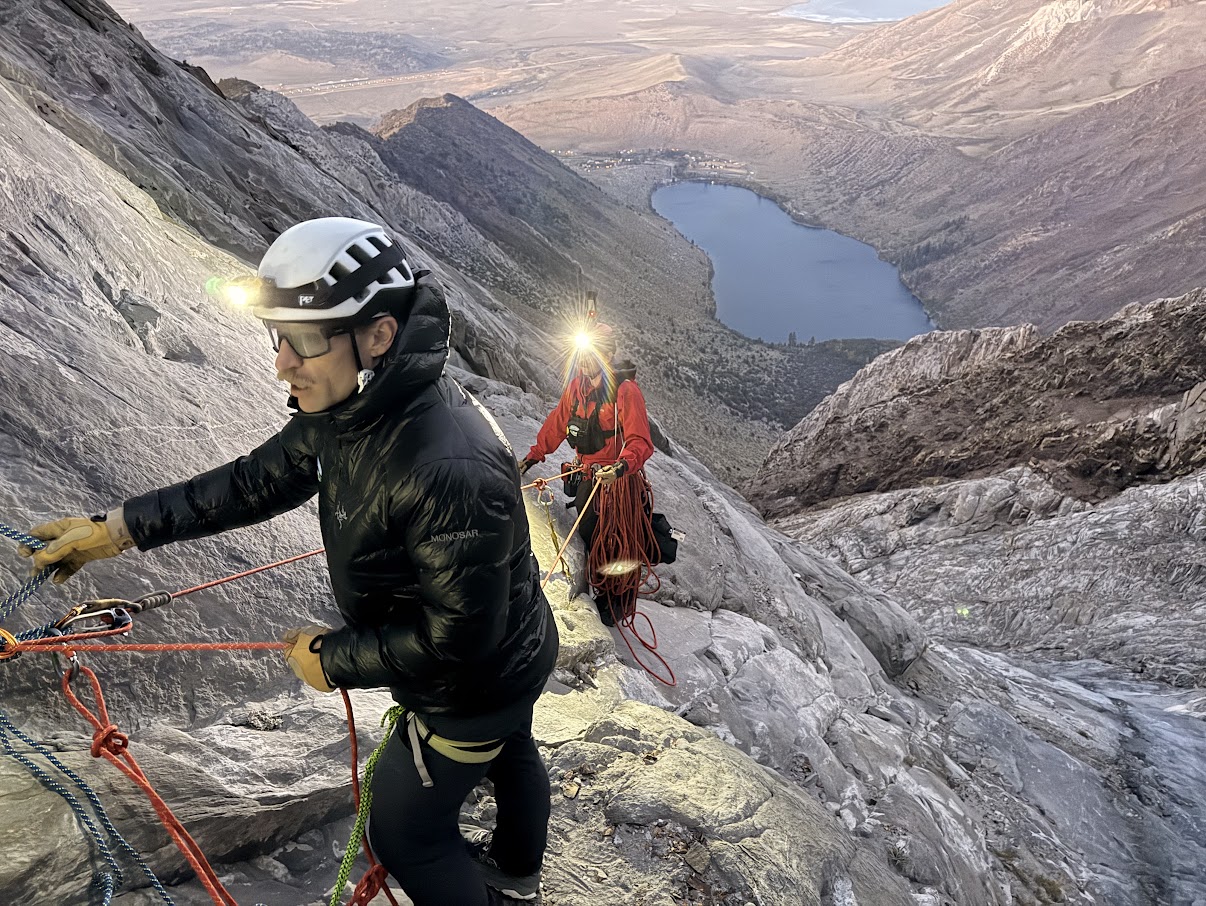
Technical team beginning the lower operation just before nightfal.
After the rigging equipment and final four-person technical rescue team were consolidated in the couloir, the team constructed a four-bolt rescue anchor with Petzl removable bolts and utilized one of the 600-foot ropes. The other 600-foot rope had been stashed by rescuers higher in the couloir due to weight. The rope was divided into a 400-foot section for the patient attendant and a 200-foot section for a line attendant. Due to operational necessity, coupled with the nature of the terrain, a single rope system was deemed acceptable.
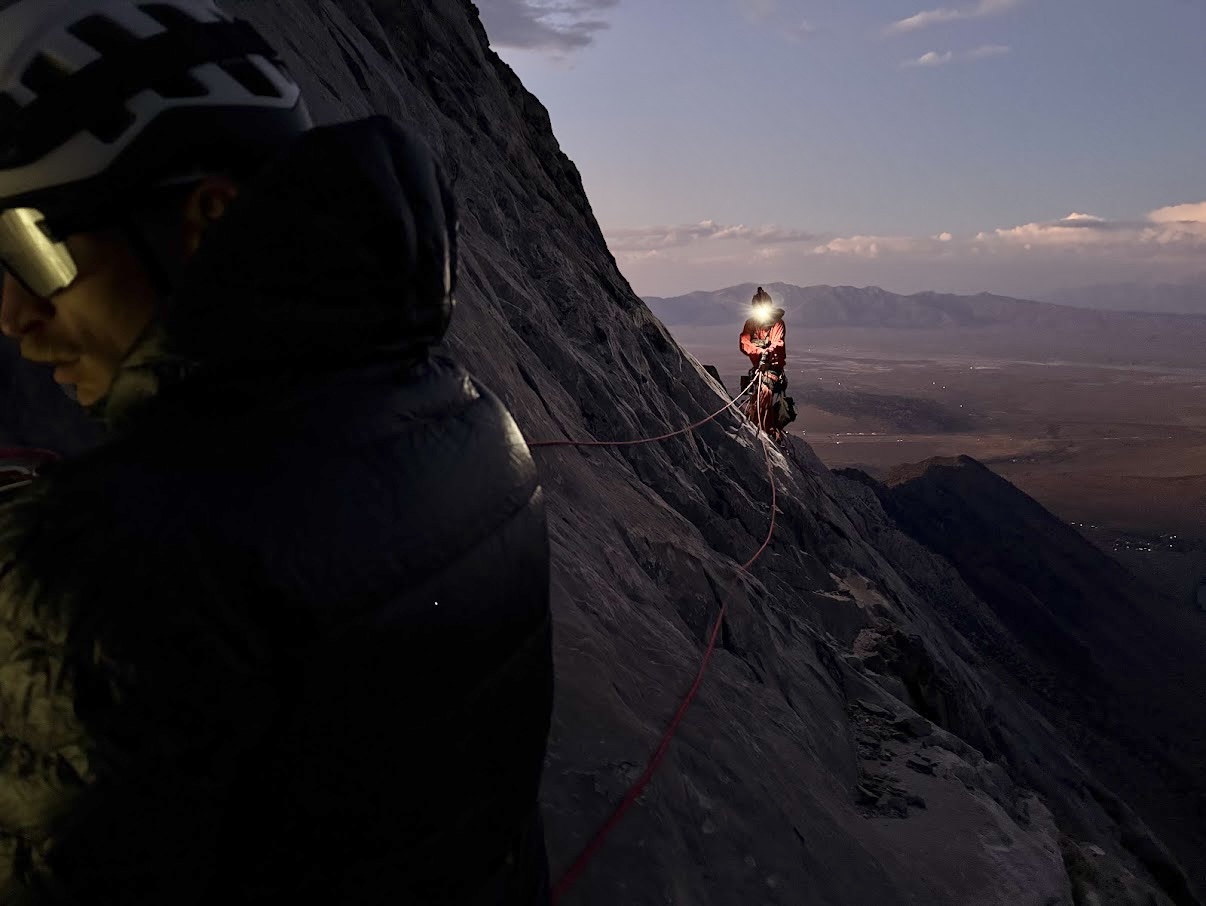
Technical operation moving laterally above subject.
As night fell, the patient attendant maneuvered approximately 225 feet laterally from the anchor until positioned above the subject, placing removable bolts along the way. After placing a strategic bolt above the subject, the attendant was lowered to his location and the subject was secured into the rope system. The subject and rescuer were lowered an additional 155 feet to a larger ledge below.
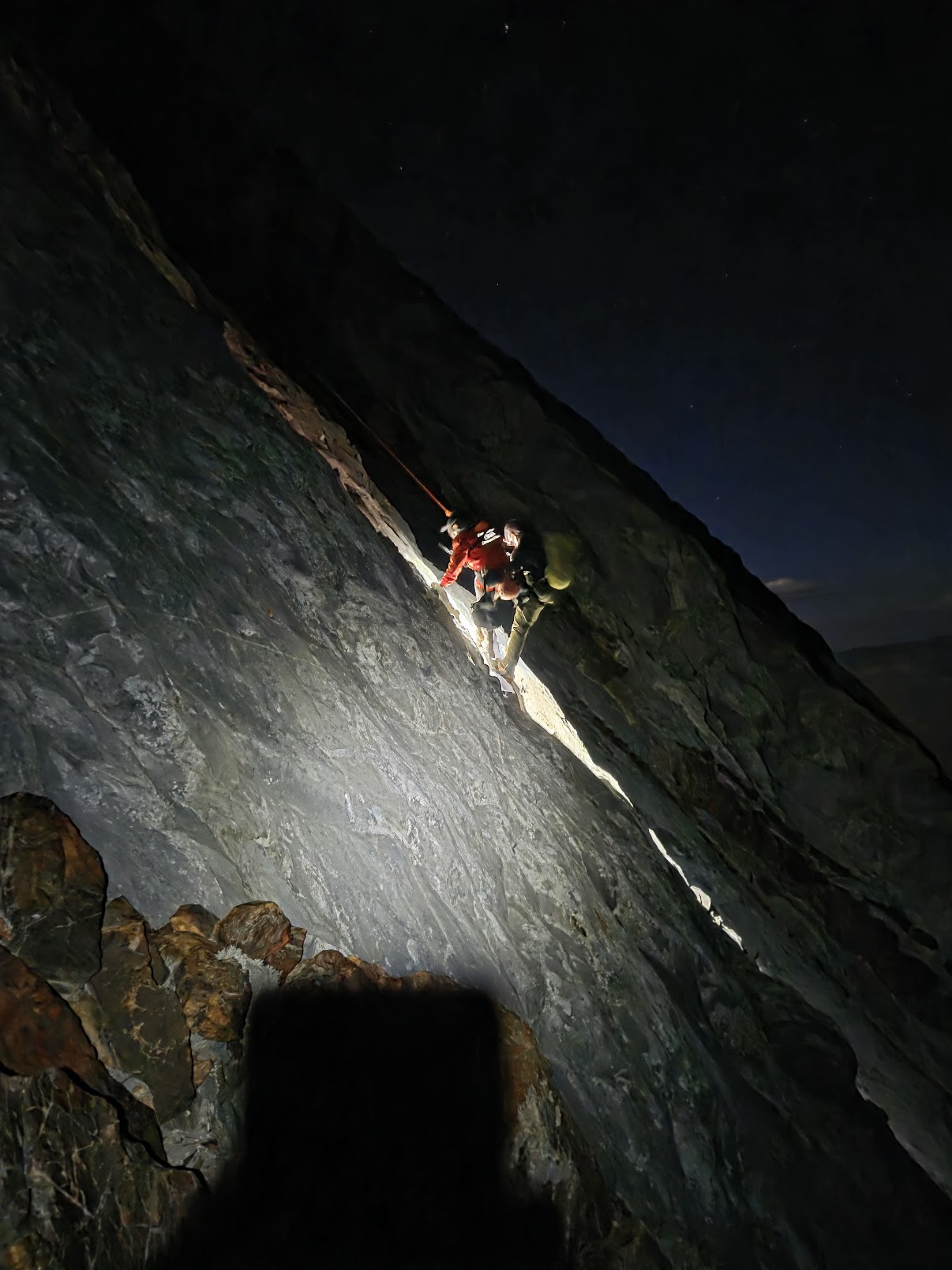
Subject is secured to system and lowered to fixed line.
The second line attendant rappelled with the 200-foot section and added 50 feet of 8mm cord, creating a 250-foot fixed line for the remaining rescuers and subject to lower diagonally out into the main route and then ascend toward the anchor. From the anchor, all parties ascended on foot. All four rescuers and the subject topped out at 0045 hours. The group descended the long, scree and talus-covered southwest side of Laurel Mountain to the saddle, then continued approximately 1.5 miles down the trail to the 4×4 road. An awaiting OHV transported the group back to the trailhead and the operation was terminated at 0430 hours.
Overall, the team was pleased with the positive outcome of the operation. Several operational issues introduced delays and additional complexity but ultimately did not prevent the team from completing the rescue safely. However, if not resolved, some of these issues could have materially impacted the rescue efforts. These issues were largely the result of moving quickly, miscommunications, and approaching the incident from a direction that differed significantly from historical practice. The incident reinforced the importance of equipment and ICS accountability, particularly when splitting critical equipment between multiple insertion methods and teams.
Despite the communications challenges inherent in remote alpine operations, including limitations with hand-held radios and T-Satellite devices, the team maintained sufficient coordination to complete the rescue. Heavy winds and team separation in highly challenging terrain required the technical rescue team to communicate exclusively by radio, increasing the volume of traffic.
Extensive training, trust in teammates, and thoughtful execution ultimately made this challenging nighttime technical rescue successful. The team also identified that, had all critical equipment arrived in the field without delay, the technical component of the rescue may have been completed before nightfall.
Mitchell Quiring is a board member and public information officer for Mono County Search and Rescue, which is an associate member of the MRA.