In 2022, MRA and Montrose Search and Rescue team member Mike Leum was asked to join a mission to the Ukraine to help a group of special needs orphans who had been abandoned because of the invasion by Russia. Jack Osborne, the son of rock star Ozzy Osbourne and acquaintance of Leum, was involved in the effort and asked Leum if he wanted to join. The mission was organized by Third Wave Volunteers and Leum invited SAR teammate and pediatrician Dr. John Rodarte to go with him. Helping the orphans proved complicated, Leum said, as they could not take the children out of the country without visas and permission, so the mission shifted to getting people to the border, assisting with paperwork and sending medical kits to the front lines. “It didn’t end up being what we hoped it would be, but it was still meaningful,” said Leum, a 33-year member of the Montrose team in Los Angeles.
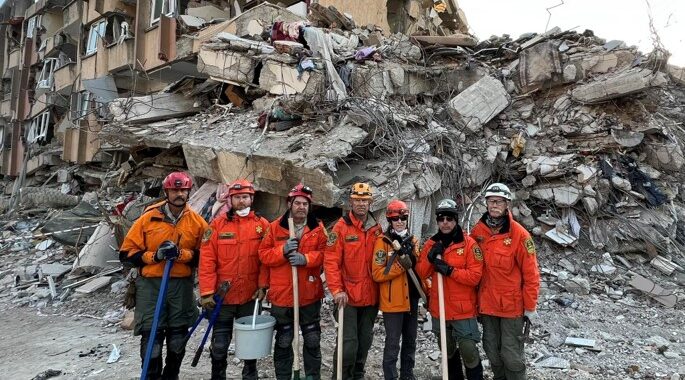
It also started Leum on a path to participating in international SAR missions and starting his own foundation to help facilitate that effort, 6:8 International Rescue. He and his colleagues have traveled to Greece, Thailand and Turkey to assist in search and rescue efforts. The team has deployed outside California twice under the auspices of the Los Angeles County Sheriff’s Department, first in Turkey in 2023 after an earthquake, and in North Carolina in 2024 after Hurricane Helene. Deployments in Greece to look for a missing retired deputy and in Thailand in 2025 after an earthquake were not sanctioned by the LASD, so members deployed as private citizens or volunteers for the rescue foundation.
Search and rescue volunteers have skills and experience that can be useful in situations of missing Americans abroad, or large search and rescue or recovery operations after disasters both in the U.S. and in countries with limited resources. But it can be hard to be deployed as local sheriff’s departments don’t have the authority to deploy internationally and federal agencies, like the Federal Emergency Management Administration, have their own resources to send. Still, some MRA teams or individual members have done work abroad as private citizens or with other rescue organizations like Third Wave Volunteers or Team Rubicon.
Alison Thomson founded Third Wave after she rushed to the World Trade Center when the towers were struck in 2001. A paramedic and nurse by training, she stayed at Ground Zero for weeks assisting firefighters and providing medical aid. This work inspired her to start Third Wave, a non-profit that sends volunteers to disaster areas around the world. In December she was in Jamaica assisting in recovery efforts after the devastating hurricane there. She will return there in January to help get a temporary hospital set up to serve residents.
Team Rubicon, another aid organization that sends volunteers to assist after disasters, was started after eight volunteers deployed to assist after the 2010 earthquake in Haiti. Rubicon is run primarily by veterans, but anyone can sign up online by filling out a basic form with skills, operation interests and volunteers goals. A background check is required and there are also levels of volunteering based on trainings completed and skills.
Organizations need people with varied skills, from urban search and rescue to administrative tasks to medical training. “Everyone is needed” is Thompson’s motto. Usually some sort of lodging is provided, often tents, but occasionally hotels or other places to set up, as well as meals while volunteers are working. Transportation to the disaster or response sites is more complicated and can sometimes be provided, but is also sometimes on the volunteers to sort out. Thompson said they have had private planes bring people in when they are flying in supplies. Leum has used Air Link, which is a nonprofit that gets airline mileage donations and uses them to move volunteers to needed sites around the world. Air Link was founded in 2009 and had its first response when it transported 2,000 doctors and nurses as well as supplies on private and commercial flights to Haiti after the 2010 earthquake.
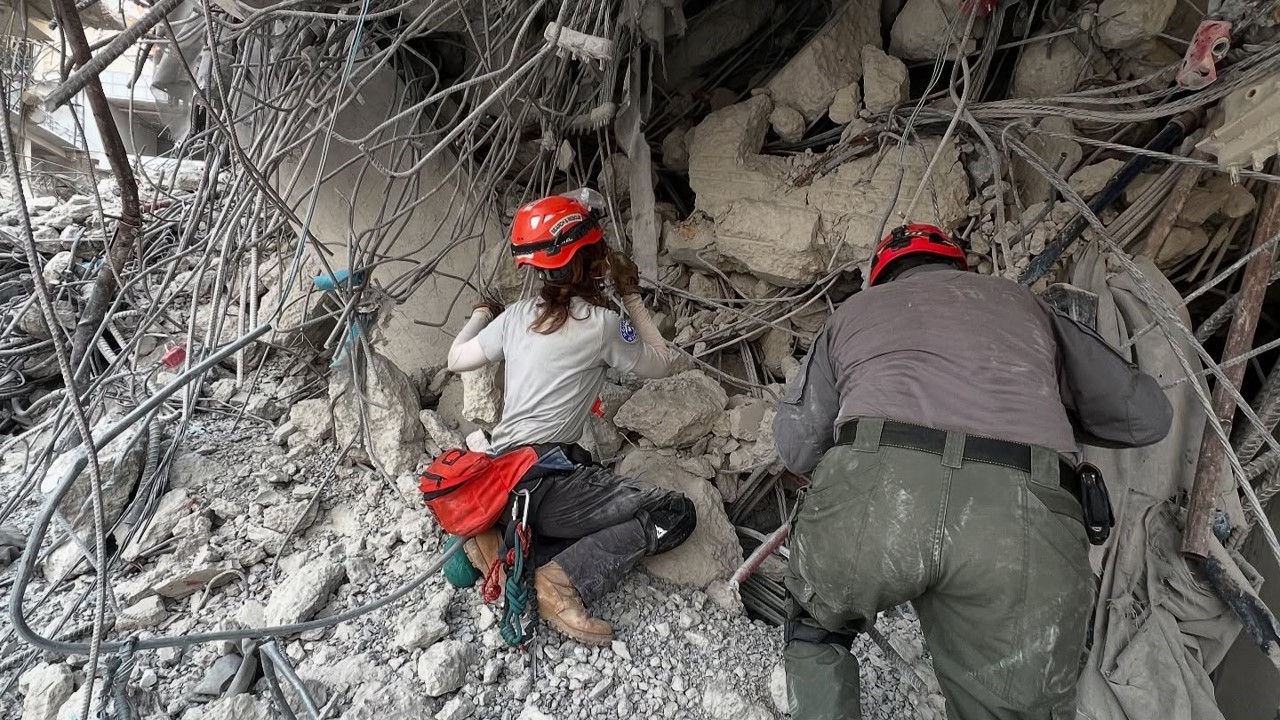
Challenges facing searchers traveling abroad range from travel to bringing specialized equipment, as well as coordinating with local efforts and collaboration on investigations. Leum said his team has to have a solid connection with someone in country to help facilitate travel and logistics. “Those types of contacts are the hardest part, “Leum said. In Turkey this was AFAD, the Turkish equivalent of FEMA, who had a station set up in the airport for arriving first responders. They walked Leum and his team to a map of the country showing where help was needed and where resources were already deployed. The L.A. county team saw that there was no one deployed in the south, near Syria, so they picked up three rental cars and headed down to investigate coordinates where someone had reported a voice in the rubble. The team had three live finds in collapsed buildings in that area.
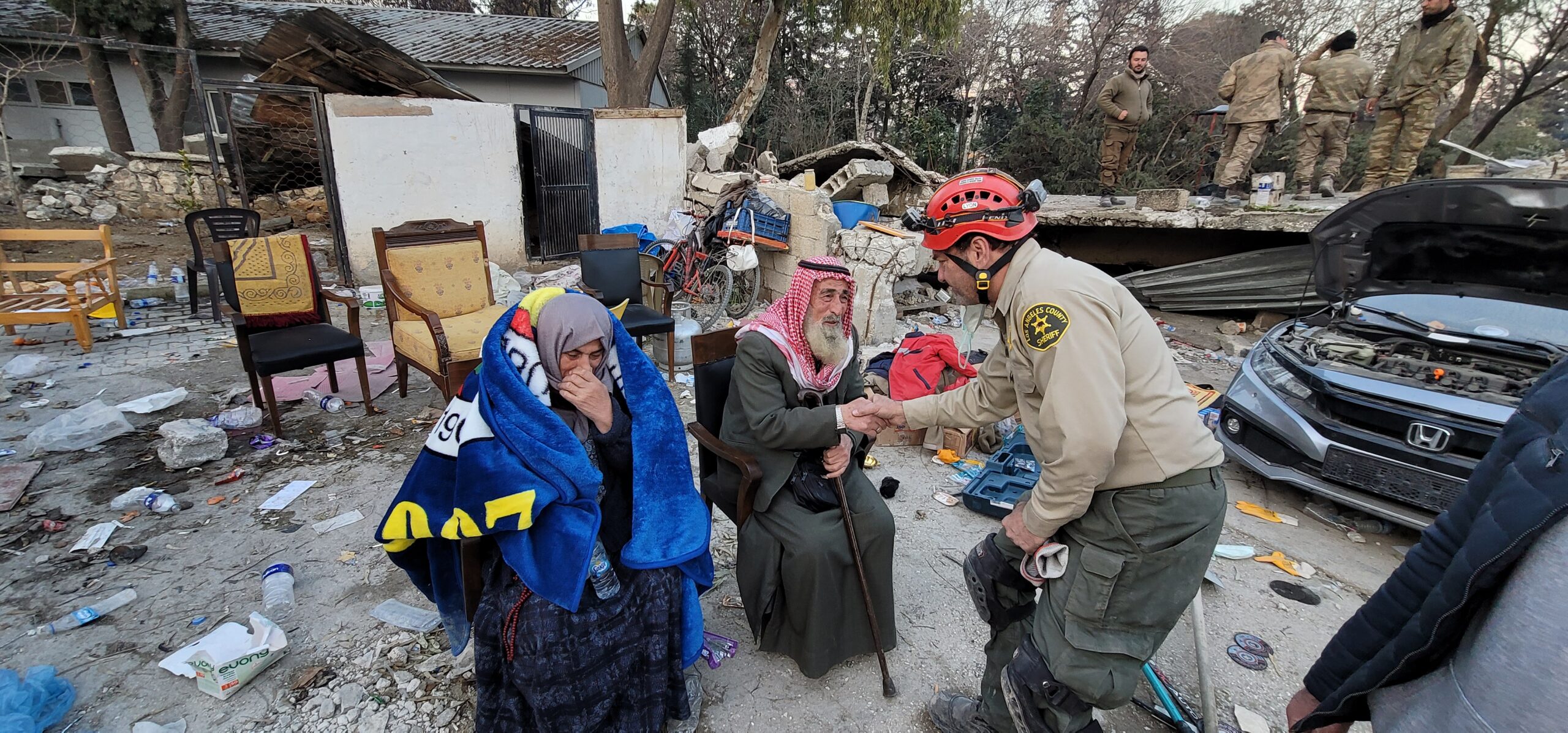
Brad Lyon with the grandparents of one of the people his team helped pull from a collapsed building.
Brad Lyon, training officer for the Santa Clarita Valley SAR team in LA County, has been on every mission with Leum and serves as the Chief Financial Officer for the foundation. He said sometimes the team wants to go, but the in country contact doesn’t materialize. Recently, the team was trying to work on a plan to respond to Jamaica after the hurricane but couldn’t get a clear mission or organization to work with. “That just did not come together,” Lyon said. “We decided not to go.”
In disasters or weather events, the need and mission can be clear, but when Americans go missing abroad, the request for help can be harder. Families who have had their loved ones go missing have been surprised how little help the U.S. Embassy or consulate is able to provide. Local authorities are the first point of contact if someone makes the report in country, but if families have to make the report from home, it adds time and complexity to the search. American Patty Wu-Murad’s family discovered this after she went missing while hiking the Kumano Kodo trail south of Osaka, Japan in April 2023. It took four days for the Japanese government to report her to the American authorities. By the time her family got involved, her phone was likely dead and several days had gone by with no search efforts. Even once it was clear that she was missing, cultural differences in looking for missing people delayed resources and frustrated the family.
The family reached out to the National Association for Search and Rescue (NASAR) and were referred to teams across the country who might be able to help. Because the family was well-organized and had raised money through a GoFundMe campaign, they were able to pay expenses for travel. Michael St. John, who has been working in search and rescue for 45 years and is the Unit Leader for Marin County’s Search and Rescue team, was able to gather a group of 21 trained volunteers from California and Hawaii, who were on a plane within 24 hours. Private, paid search teams also joined the effort, but after several weeks, no clues were found. Wu-Murad’s remains eventually were found in April 2025 by a member of one of the private teams who returned after clues were located by local fishermen.
Leum and Lyon also responded to a missing U.S. citizen in Greece in 2024, one of the missions that was not sanctioned by the Sheriff’s Department. Retired Los Angeles Sheriff’s Deputy Albert Calibet went missing after a hike on the small island of Amorgos in Greece in June 2024. His brother Oliver Calibet had pleaded for more assistance in the search from the U.S. authorities. In a video posted on YouTube, Oliver said he had gotten no assistance from the United States government and he was frustrated. “The U.S. is not doing anything for me. Nothing,” he said in the video. Leum’s group sent two waves of searchers over two weeks to scour the area where Calibet had been hiking, but no clues were found and Calibet remains missing.