The 76th ICAR Assembly of Delegates was held in October 2025 on the final day of the annual ICAR conference, which was in Jackson Hole, Wyoming. It marked only the second time in ICAR history that the conference has been in the United States, according to the report from Tom Wood. All eight of the MRA’s delegates were present, with most giving presentations or assisting with workshops and participating in the Assembly of Delegates. Two notable items came up in the assembly meeting, which is made up of about 120 voting members. Agenda items are voted on in person with handheld cards, which is time consuming and tedious and required several recounts. Members hope that an updated digital platform for voting will be in place by the next meeting. The ICAR Executive Board this year decided to allow proxy voting, which has never been allowed and may be in violation of both the organization’s bylaws and Swiss Law, according to the report. MRA delegates felt this action needed further clarification before the 2026 meeting, which was approved. This didn’t prevent proxy voting in the 2025 meeting, and more than 20% of votes were by proxy.
Several new organizations were voted on and approved by the AOD, including three in the U.S. Typically, the MRA is notified when U.S. organizations are applying for membership, but that did not happen this year. The MRA will reach out to the Executive Board to make sure that it does not happen again. The three new organizations approved were Two Bear Air Rescue Foundation in Montana, Responder Alliance in Colorado (both as Category B members with one vote) and the University of Vermont Wilderness Medicine Section as a Category C member with no voting rights. The full Assembly of Delegates report can be read here.
The MEDCOM report from Dr. Alison Sheets and Dr. Christopher Van Tilburg noted the practical day was full of workshops starting with a session on “Rescue at Very High Altitude” by Dr. Jenn Dow, Medical Director for Denali National Park. The tabletop exercise had groups of rescuers with varied backgrounds solving complex rescue problems that are “typical” near the summit of Denali. Afternoon sessions had three workshops on A, B, C, D’s – Best practices, new techniques and technologies for mountain rescue. Airway adjuncts and pro-tips were shown, a circulation presentation focuses on shock, CPR, blood product in the field, tourniquets and other circulatory issues. The final workshop was on disability, with a discussion of updated Wilderness Medical Society Clinical Practice Guidelines on Spinal Cord Protection. The authors noted this change in pre-hospital management of the spine has been going on for a while, some agencies are still thinking “spinal immobilization” rather than the updated and preferred “spinal motion restriction.” Check out the full report here.
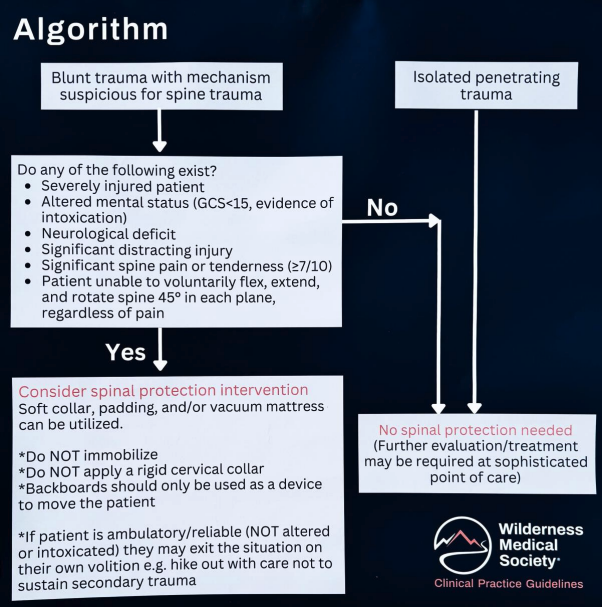
Flow chart for new guidelines on Spinal Cord Protection.
The Avalanche Commission report from Heiko Stopcock and Stephanie Jones said practical sessions at the Jackson Hole Ski Resort were excellent hands-on opportunities to work on hypothermia packaging and treatment. There were also demonstrations of intermittent CPR and CPR in a litter. There was time to work with transceivers as multiple manufacturers were present and teams rotated through stations to learn about dew features and how to troubleshoot. There were also presentations from ICAR members with snowpack and national accident summaries. Of note in the U.S., statistics show a rise in incidents involving entire parties. Globally, teams noted that more incidents are involving ice climbers and mountaineering community, who often do not wear transceivers. Read the full report here.
The Aviation Commission report from Dale Wang and Charlie Shimanski said a major theme was to share administrative and institutional challenges for air rescue operations globally. There was a case report from Kyle Nordfors highlighting use cases for drones in search, ground team support and overwatch. A demonstration and classroom session from Dave Weber focused on methods for hoist and short haul when the rescue is also connected to a ground anchor. The authors noted that past accident reporting sessions had focused on mishaps with fatalities or injuries, but this year there were three “near-miss” case studies, including entanglement of a paraglider chute in a river, damage to a cable during a hoist and an engine failure during training. See the full report here.
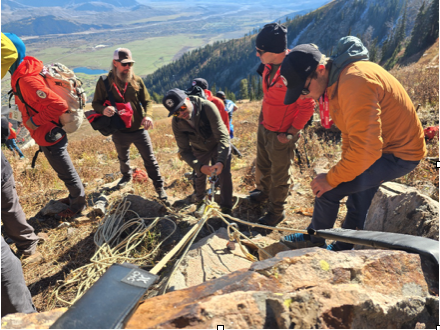
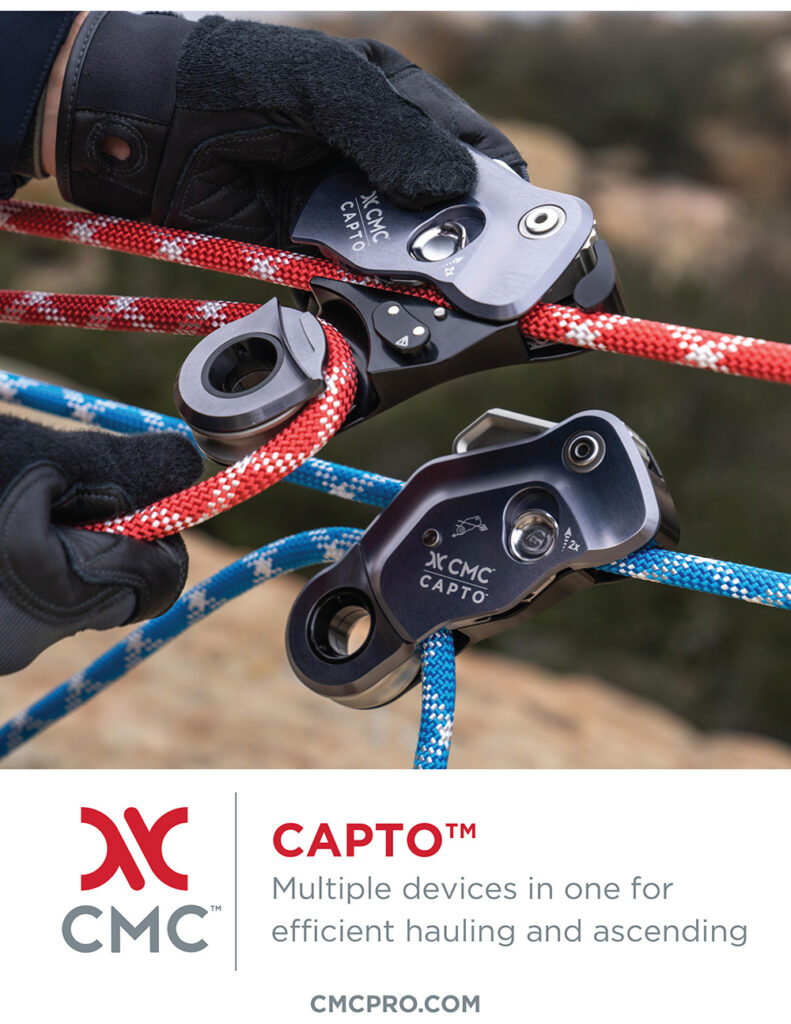
Practical Day attendees test our the load strength of a multi-point load-sharing anchor at the CMC station.
The Terrestrial Rescue Commission report from Tom Wood and Rich Siemer highlighted the hands-on opportunities available during the practical day, which had a theme of managing risk and meeting societal needs. There were 12 stations for the 400 participants to rotate through, including a lightweight rescue station, an anchoring and bolting station, a Shared Tension Rope System set up and a guiding line demonstration. Notable among the presentations was an update from Robert Koester, author of Lost Person Behavior, and updates in the new edition of that book. Koester has added many new subject categories and also discussed how satellite locators are impacting behavior of lost individuals. The full report can be viewed here.